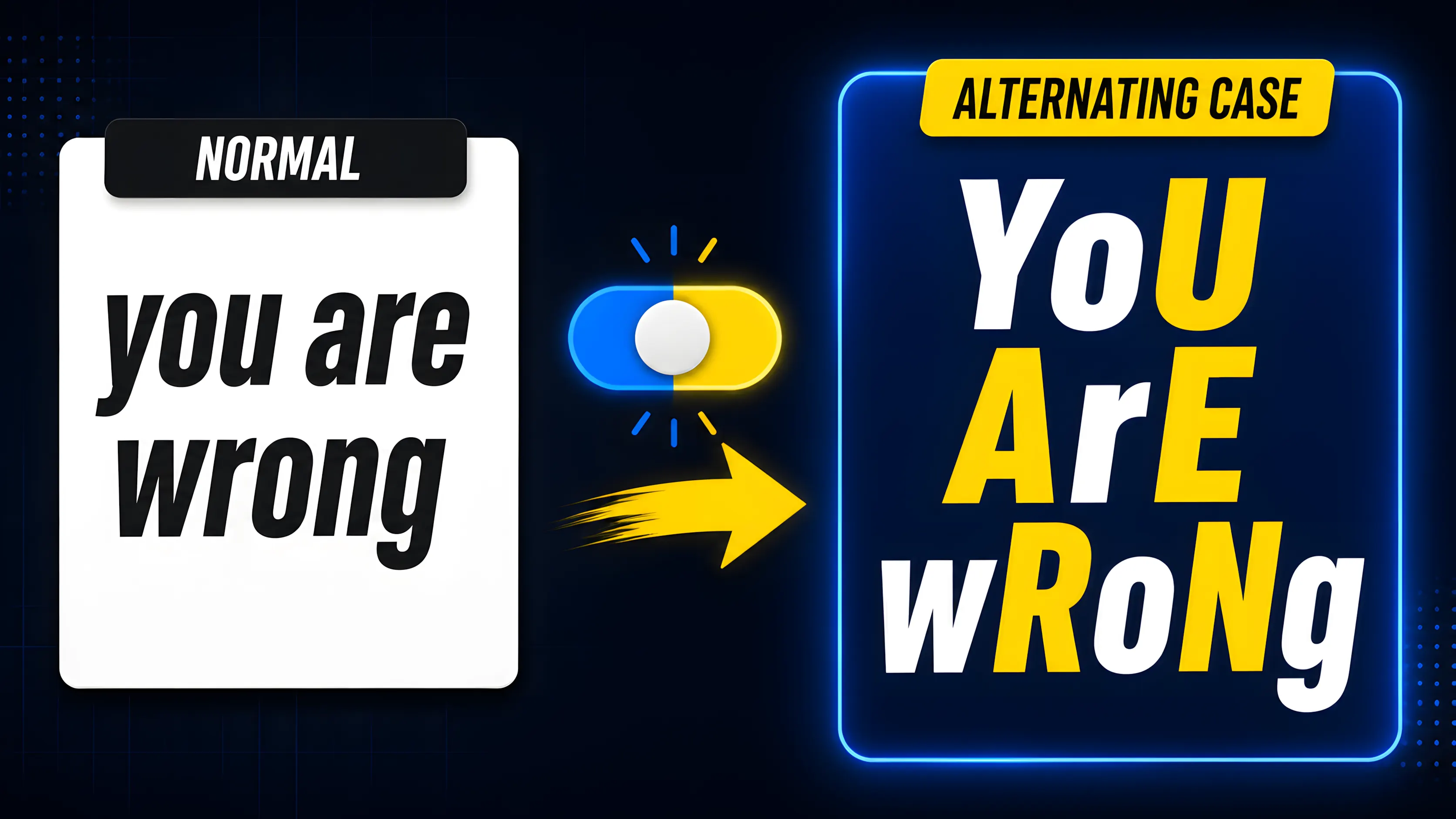
When you alternate between uppercase and lowercase letters, a plain sentence turns into something that looks like this:
Normal: You think you're right
Mocking: YoU ThInK YoU'rE RiGhT
If you've scrolled through Twitter, TikTok, or Instagram in the last few years, you've seen this style everywhere — in replies, quote tweets, comment sections, meme pages. It stops you mid-scroll because it looks off, and that's the whole point.
Alternating case has become a visual shorthand for sarcasm and mockery online. The person writing it is almost always repeating someone else's words back in a deliberately ridiculous way, like imitating a whiny voice without any audio. The style is tied to the "Mocking SpongeBob" meme format that exploded in 2017, and it has long outgrown the original image.
This post breaks down exactly how the pattern works, where it came from, why people read it as mocking, and how to use it (or understand it) when you see it in a feed. If you just want to convert a sentence right now, the alternating case converter handles it instantly.
What "Alternate Between Uppercase and Lowercase Letters" Means
The basic pattern
The rule is simple enough to say in one sentence: each letter switches case from the one before it.
Start with uppercase and the word "hello" becomes HeLlO. Start with lowercase and it becomes hElLo. The two common variants applied to a full phrase:
- Start uppercase: YoU ThInK YoU'rE RiGhT
- Start lowercase: yOu tHiNk yOu'Re rIgHt
Spaces, punctuation, numbers — none of those change. Only letters flip. A question mark stays a question mark. The number 42 stays 42. The pattern only touches characters that have an uppercase and lowercase form.
How it looks versus normal text
Side by side, the difference is immediate:
| Normal text | Alternating case |
|---|---|
| you are wrong | YoU ArE WrOnG |
| this is fine | ThIs iS FiNe |
| i love this movie | I LoVe tHiS MoViE |
That jagged, stuttering look is what makes it jump out of a feed. Regular text flows smoothly. Alternating case looks like it's been through a blender, and that visual disruption is doing real work — it signals that the words are not meant to be taken at face value.
Why it's not random
A common first impression is that people are just hitting Caps Lock at random. They're not. Alternating case follows a strict pattern, letter by letter, which is why a sentence formatted this way looks the same no matter who types it (or which tool generates it). That consistency is part of what makes the style instantly recognizable. One glance and you know what's happening.
Where This Style Came From: The Mocking SpongeBob Meme
The meme in plain terms
In May 2017, a screenshot from an old SpongeBob SquarePants episode started circulating online. The image shows the character standing in an exaggerated pose, looking vaguely like a chicken, and beneath the image people wrote someone else's words in alternating case. The format was dead simple: an original statement on top, the mocking version underneath, SpongeBob in the middle.
The combination spread fast — Twitter, Instagram, Reddit, Tumblr, meme pages on every platform. Know Your Meme documents the timeline, and by mid-2017 it had become one of the most used meme templates of the year.
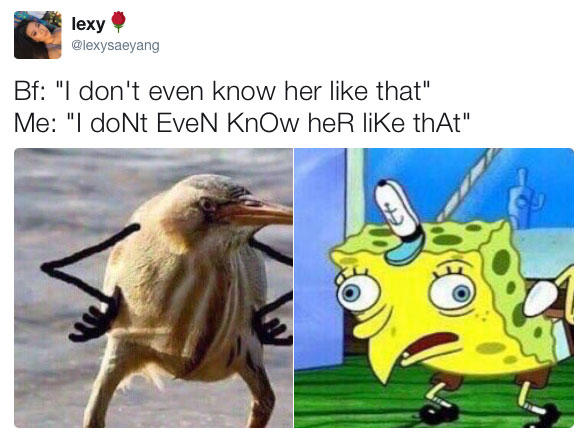
Example from Know Your Meme, uploaded by Matt on May 9, 2017.
From image to text-only
Here's the part that matters for understanding alternating case today: people stopped needing the image. The text style alone started carrying the entire joke.
A typical exchange in a reply thread:
Person A: I never watch movies twice
Person B: i nEvEr wAtCh mOvIeS TwIcE
No picture. No caption. Just the alternating case, and every regular internet user knows exactly what tone is being set. The formatting became the meme.
Why the pattern works as a mocking signal
Three things happened at once:
Visual distinctiveness. Alternating case looks wrong compared to everything else on a page. That contrast grabs attention the way a raised voice does in a quiet room.
Built-in tone. Readers interpret it as joking, skeptical, or dismissive almost instantly. You don't need to add "lol" or "I'm being sarcastic." The capitalization pattern does that job.
Cultural shorthand. Once enough people used the style, it became self-reinforcing. New users learned it by seeing it, and the meaning stuck without anyone needing to explain the SpongeBob connection. It became its own thing.
How Alternating Case Creates a Sarcastic Tone
Mimicking exaggerated speech
There's something about seeing HeLlO tHeRe that makes your brain read it in a sing-song, exaggerated voice — the kind of voice someone uses when they're imitating a child or being deliberately over-the-top. That visual rhythm, up-down-up-down, mirrors the pitch swings of someone mockingly repeating your words back at you.
That connection to spoken mockery is probably why the style landed so hard. Sarcasm in text is notoriously difficult. Tone of voice doesn't come through in plain writing. Alternating case solved that problem in a way that italics, quotation marks, and "/s" tags never quite managed.
Contrast with normal writing
The power is in the comparison. Watch what happens with the same exact words:
"You think you're right" — reads as a straightforward observation. Could be neutral, could be serious.
"YoU ThInK YoU'rE RiGhT" — reads as teasing, dismissive, possibly a full-on clap back.
The words haven't changed. Not a single letter is different. Only the presentation shifted, and that shift flipped the entire tone. It's a good reminder that how something is said matters as much as what's said, online and otherwise.
Why it works in short-form content
Twitter has a character limit. TikTok comments are short. Instagram replies scroll fast. In environments where you get maybe one sentence to land a joke, alternating case does triple duty:
- It carries the sarcastic tone without needing extra words to explain the joke.
- The jagged look physically stops the scroll — your eye catches the uneven pattern.
- Using it signals you're fluent in internet culture, which is its own form of social currency in these spaces.
A friend of mine moderates a Discord server with about four thousand members. She told me the alternating case replies started as an inside joke among three people, and within a month it was the default way anyone in the server expressed disagreement. No one taught it. People just picked it up from context.
Real-World Examples on Social Platforms
Twitter / X replies
This is where alternating case lives most naturally. The pattern:
- Someone posts a confident take.
- Someone else quote-tweets or replies with the same words in alternating case.
The implication is always the same — "listen to how silly this sounds." Examples of the kind of thing you see daily:
- ThIs iS tHe bEsT MoViE EvEr
- i'M nOt lIkE OtHeR PeOpLe
- yOu jUsT dOn'T UnDeRsTaNd
Quote tweets amplify the mockery because the original statement sits right above the alternating case version. The contrast does the roasting.
TikTok comments and captions
TikTok uses alternating case in two main spots:
Comments. Under controversial or cringey videos, the top comments often mock the creator's main point in alternating case. A video about a bold life decision might get hit with iT's aLl aBouT tHe jOuRnEy as the most-liked reply.
Captions. Creators use alternating case in their own captions to reenact what someone said to them. The visual contrast between their normal speaking voice in the video and the mocking text in the caption creates the joke.
The style pairs especially well with reaction videos and duets, where the whole format is already built around responding to someone else's content.
Instagram comments and meme pages
Meme pages use alternating case in overlays — a screenshot of a tweet or statement, with the mocking version layered on top in alternating caps. The format scales because it works as a standalone image. No context needed beyond the text itself.
In comment sections, you'll see it aimed at influencer quotes:
- My bRaNd iS dIfFeReNt
- I wAkE uP aT 4 Am
- It'S aLl aBoUt mInDsEt
Story polls and text overlays use it for comedic effect too, usually when the creator is making fun of their own earlier opinion or roasting a common take.
Reddit, Discord, and other communities
Reddit thread replies use alternating case to exaggerate someone's argument to the point of absurdity (for other looks, the Reddit font generator covers bold, cursive, and spoiler text):
- ThIs iS aCtUaLLy gOoD AdViCe
- I'm sUrE tHaT wIlL wOrK
Discord is where it gets the most casual and frequent use. Someone types a statement, and another user copies it back in alternating case within seconds. It's the text equivalent of someone repeating what you just said in a funny voice at the dinner table — childish, sure, but hard not to laugh at when the timing is right.
How People Create This Text Quickly
Why manual typing is painful
Try typing YoU ThInK YoU'rE RiGhT by hand. On a phone, you're toggling the shift key for every single letter. On desktop, you're hitting and releasing Caps Lock in a rhythm. It's slow, it's error-prone, and by the fourth word you've already messed up the pattern twice.
Most people who use alternating case regularly don't type it manually. The friction is too high, especially on mobile where the shift key dance becomes genuinely annoying.
Using a mocking case generator
The workflow most people actually follow:
- Copy the sentence you want to mock (or type it normally).
- Paste it into an alternating case converter.
- Copy the result.
- Drop it into your post, reply, or caption.
One click, perfect pattern, every time. No missed letters, no broken rhythm. The consistency matters because a sloppy alternating case attempt — where you accidentally put two uppercase letters in a row — doesn't read as mocking. It just reads as broken.
How this fits into content workflows
Meme pages and content creators batch this stuff. They'll run a dozen quotes through a generator before building a carousel or a set of story frames. The tool handles the tedious formatting so the creator can focus on picking which quotes are actually funny.
Regular users do the same thing at a smaller scale. You see a take you want to roast, you run it through a converter, you paste it into the reply. The entire process takes about ten seconds, which is roughly how long the joke deserves.
When Not to Use Alternating Case
Serious or sensitive topics
Alternating case reads as mockery. Always. There is no way to use it on a serious topic without coming across as dismissive, and there are subjects that deserve more than dismissal.
Using mocking case on someone's genuine struggle, a sincere question, or a sensitive issue doesn't land as humor. It lands as cruelty. The line between a good joke and a cheap shot is thinner than people think, and alternating case sits right on that line. Something worth pausing over before hitting send.
Professional or public-facing accounts
Brands and businesses that use alternating case in official communications confuse people more than they entertain. The style only works when the audience already shares the cultural context, and a company's audience almost never does uniformly.
Professional profiles — LinkedIn especially — are another place where mocking case sticks out for the wrong reasons. A hiring manager scanning your profile is not going to read YoU ShOuLd hIrE Me as charming self-deprecation.
Misinterpretation risks
Not everyone grew up online, and not every audience is plugged into meme culture. In cross-cultural conversations, mixed-age groups, or any space where the readers might not share the same reference points, alternating case can read as:
- A typo or keyboard malfunction
- Deliberately confusing formatting
- Rudeness with no clear purpose
If you're not sure your audience will get the joke, it's not a joke worth making. Genuine kindness often means skipping the comeback entirely — not because it wouldn't land, but because building people up tends to be more worthwhile than tearing statements down.
How to Read Alternating Case When You See It
If you spot a sentence in alternating case in a comment section or reply thread, the writer is almost certainly doing one of three things:
- Mocking the statement — repeating someone's words back to highlight how they sound.
- Exaggerating for comedy — blowing a minor point up to absurd proportions.
- Signaling sarcasm — saying the opposite of what they mean without adding "/s" or "just kidding."
Context helps. Look at what the alternating case message is replying to. Ask yourself: "What statement is being repeated or exaggerated here?" That usually makes the joke click.
The tone can range widely. Between friends it's light teasing, the text version of a playful elbow nudge. In arguments or call-out posts, it edges toward something harsher. Reading the room — the thread, the relationship, the platform — matters as much as reading the words.
Other case styles to try
Use Lowercase to return a draft to all lowercase, Uppercase for an all-caps label, or Sentence Case for ordinary prose. If you want to flip each existing letter's case rather than alternate by position, use Inverse Case.
Conclusion
When people alternate between uppercase and lowercase letters online, they're almost always signaling sarcasm or mockery. The style became a universal internet shorthand after the Mocking SpongeBob meme spread in 2017, and it has since outgrown the original image entirely. The alternating pattern is consistent and instantly recognizable, it works as a visual tone marker in places where tone is hard to convey, and it shows up on every major platform from Twitter to Discord.
Understanding this style helps you read online conversations more accurately. And if you want to use it yourself, an alternating case generator handles the letter-by-letter formatting so you can focus on the timing and the target — which, honestly, are the parts that make or break the joke.
FAQs
What does it mean when someone types in alternating caps? They're mocking or being sarcastic. The alternating case pattern signals that the words are being repeated in a ridiculous tone, like imitating someone in a silly voice. It became standard internet shorthand through the Mocking SpongeBob meme.
Is alternating case the same as random capitalization? No. Alternating case follows a strict letter-by-letter pattern (upper, lower, upper, lower). Random capitalization has no pattern. The consistency of alternating case is part of what makes it recognizable as mocking rather than just messy typing.
How do I type in alternating case without a tool? You toggle the shift key for every letter, which is tedious and easy to get wrong. Most people paste their text into an alternating case converter instead, which applies the pattern instantly with no errors.
Can I use alternating case in professional settings? It's best to avoid it. The style reads as mockery in every context, and professional communications call for clarity, not meme formatting. Save it for casual social media posts and conversations where the audience will understand the tone.
Where did the mocking text meme come from? The Mocking SpongeBob meme emerged in May 2017 from a SpongeBob SquarePants screenshot. The alternating case text was paired with the image to show a mocking tone, and the text style eventually became its own standalone format.
Related: Case Converter, Browse more text and social guides.